 While cloud storage is convenient, it’s not the cheapest storage option. Yes, the fierce competition between companies like Carbonite, Mozy and CrashPlan has led to dramatic price drops for services, but there exists an even cheaper method of cloud data storage called Amazon Glacier. Boasting fees as shockingly low as $0.01 per GB per month, Amazon Glacier seems poised to snatch up every last customer in both the consumer and enterprise market. So what’s the catch? Surely there’s a catch, right?
 The “Other” Low-Cost Amazon Cloud Service
Amazon already offers a relatively inexpensive cloud storage service called Amazon S3 (short for Amazon Simple Storage Service) and it’s proven to be wildly popular, with excess of two trillion user files stored, according to Amazon. But at a rate of $0.095 per GB per month for the first TB, that’s still almost 10x what you’ll pay with Amazon Glacier.
With S3, it’s essentially a snap. With Glacier, retrieval of
data can take between three and five hours just to begin processing, and
you’re charged extra for the bandwidth necessary to access your stored
information or any file.
And then Make Self Serving It
For this reason, you may want to put some thought into which of Amazon’s offerings is ideal for you. If you’re thinking you’ll want to access your stored data on a regular basis, stick with S3. If you’re thinking of using Amazon Glacier as “cold storage,” a place to permanently archive gigs and gigs of irreplaceable data you’ll probably never want to access again, or that you’ll only ever need to access in an emergency, then you’re on the right track and the:
After you Do anything:
 Having said that, there’s good news. You don’t have to have a degree in computing to figure out how to work Amazon Glacier (although it wouldn’t exactly hurt). You just have to be patient enough with yourself to figure out how to make it work for you. Here are a few tips to help you out.
First things first, you’ll need to set up an Amazon Web Services (AWS) account. AWS is sort of like the entry portal that gives you access to an enormous variety of cloud computing goodies, including apps, software, and 30GB of free block storage or 5GB of free object storage. You’ll need have or use account Glacier so on.
 And Then you will Get Equipped
Next, you’ll be required to download a third party external client to facilitate storage and retrieval. As we mentioned before, one of the drawbacks to Amazon Glacier is the lack of any platform to help you get your stuff uploaded. While enterprise data experts will already be equipped, the prospect could be a bit daunting for the average Joe or Jane. The good news is that there are a few reliable third-party software platforms out there to assist.
One of the best out there at the moment is called Fast Glacier, and it’s free to use for consumer purposes. A commercial license can be purchased for $29.95. Fast Glacier is a Windows-only platform, so if you’re running a Mac or a Linux machine you’ll need to find something else. Simple Amazon Glacier Uploaded (SAGU) is Java based, therefore plays well with Windows, Mac or Linux.
 Fast Glacier’s folder sync tool also provides easy syncing between local and remote storage locations. The folder sync tool compares what you’ve previously uploaded to Glacier with the contents of your local folder and gives you numerous syncing options, including uploading only files that are new or that have changed, keeping both versions, and deleting any files from Glacier that you no longer have in local storage.
According to the developer’s website, the free version of Fast Glacier is intended for use only by consumers. If you own a business, you’re required to download a Fast Glacier Pro license for $39.95.The pro version enables faster uploading through better multi-threading support. The free version limits uploads to two concurrent uploads, whereas the pro version doesn’t. Pro lets the user set the number of simultaneous uploads, effectively enabling the use of full network connection speed.
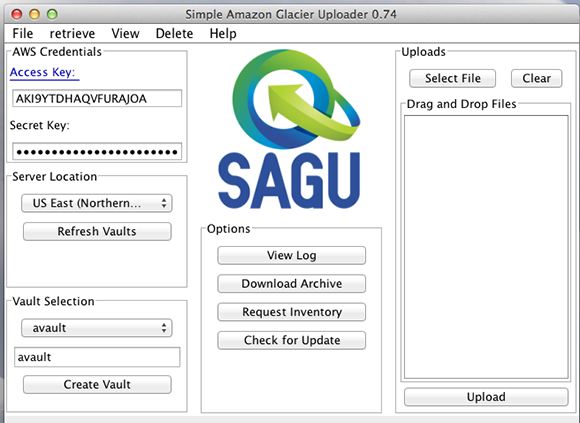
SAGUSimple Amazon Glacier Uploaded (SAGU) works in a similar manner to Fast Glacier, earning the “simple” in its name by delivering full upload/download, vault creation and management, and region selection in a single window. Once you’ve provided your AWS login credentials, there’s no additional configuration required. There’s not even any file installation required after you’ve downloaded the file, which comes available in .jar format. Files can be accessed and uploaded or retrieved using traditional “select file” or drag and drop. Inventory of uploaded files can also be performed with a single button.
 And Then Pleas Uploading Your Data
Amazon Glacier works by allowing you to upload individual files or batches of files, called archives. Archives can be as large as 40TB and are stored inside of vaults that you create and name. You can create as many as 1,000 vaults per region. There are three available regions within the United States:
This essentially means endless room for storage. Each vault can be
assigned notifications to let you or your work team know when specific
tasks are completed, like alerting you when uploads are complete or when
retrieval requests have been approved.


About seebedohave
Provide you to improve about computer technology knowlegde,and any solution on your computer This bloge you will get other knowlegde of computer, Thank you for visited!!!


0 comments:
Post a Comment